
Water Sort: Color Sorting 3D
WaveTech LimitedCasual
4.6138.00 Reviews
- Version
- 1.10.4
- Installs
- 1.00M
- Age Rating
- Everyone
Screenshots

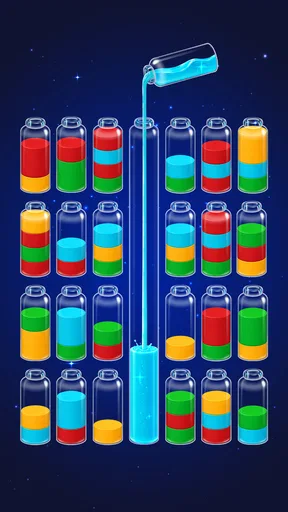
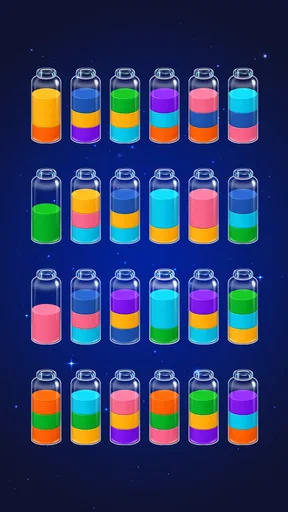
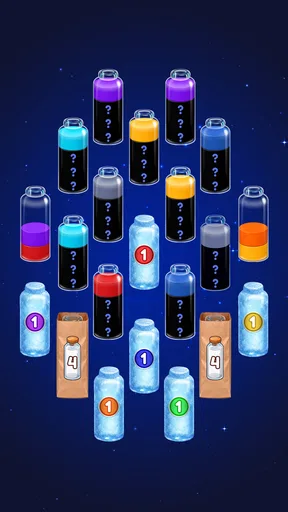
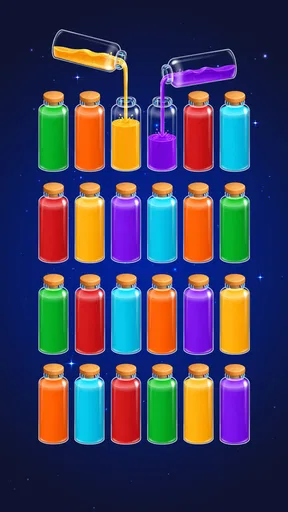
Our Review of Water Sort: Color Sorting 3D
 Analysis by Appyee
I picked up Water Sort: Color Sorting 3D expecting a simple time-filler, and that is exactly where it works best: a quiet puzzle I can open for a few minutes, understand immediately, and put down without losing track of a complicated story or a long-term objective. The idea is familiar—move colored liquid between tubes until each tube contains one color—but the appeal comes from planning several moves ahead while keeping the screen pleasantly uncluttered.
That simplicity makes it especially easy to share around a household. One person can solve a level during a coffee break, hand the phone to someone else, and the next player can continue without needing an explanation of characters, controls, or a complicated account. I would describe it as a casual puzzle game for people who enjoy visual order and small logic challenges more than speed, competition, or action.
A calm puzzle that works well on a shared device
In my experience, the strongest use case is the shared phone or tablet that several people pick up at different times. A parent waiting while dinner cooks, a teenager taking a short break from homework, or two relatives passing the device back and forth can all understand the central task almost instantly. The game does not demand that everyone play in the same style, so one person can think carefully while another makes quick attempts.
That flexibility is more useful than it may sound. Many casual games are easy to start but awkward to share because progress, purchases, or personal preferences become tangled together. A color-sorting puzzle has a lower social barrier. Someone can watch another player solve a difficult arrangement, suggest a move, or simply take over when the first player gets stuck. It becomes a small shared activity rather than a game that belongs exclusively to one person.
Still, I would not treat the app as a true multiplayer experience. The enjoyment comes from taking turns, discussing a solution, or comparing approaches, not from simultaneous play. If your household wants live competition, chat, head-to-head rounds, or a visible family leaderboard, this is not the right kind of casual game. Its strength is quiet cooperation around one screen.
Why the basic loop remains satisfying
Each puzzle asks me to use empty space intelligently. I can pour a color into an empty tube or onto the same color, but a careless move can hide the color I need under another layer. The best moments come from recognizing that a seemingly helpful move creates a problem two or three turns later. That gives the game more substance than simple tapping, even though the controls themselves are easy.
I found it helpful to pause before touching anything and identify which tube is acting as temporary storage. That small habit improves the experience considerably. Rather than moving liquid randomly, I can decide which color needs to be exposed, which tube should remain open, and when a nearly completed tube is safe to finish. This is one of the less obvious strengths of the format: the game quietly rewards organization, not reaction speed.
For a shared device, that also creates a natural way to coordinate. A younger player may spot the next color match, while an older player may notice that the move would waste the only empty space. Talking through those choices is more engaging than simply watching someone tap. I would keep the conversation focused on the board, though, because the game itself does not provide a separate coordination layer.
Setting boundaries before handing it over
The game is free to install, which makes trying it with a household device straightforward. It also includes in-app purchases priced from $1.99 to $39.99 per item. That is the detail I would address before allowing children or guests to use a phone connected to a payment method. The puzzle itself may be harmless, but shared-device use can turn a simple game into an avoidable billing conversation if nobody knows which account is active.
I would establish a clear rule: play is fine, but purchases require the device owner’s permission. On a family tablet, I would also make sure the person using it understands that a move in the puzzle does not authorize any transaction elsewhere in the app. This is not a criticism of the sorting mechanic; it is simply sensible housekeeping whenever a free game offers optional paid items.
There is another useful boundary: decide whose progress matters before several people begin playing. If everyone takes turns on one installation, later players may change the position or solve a puzzle that someone else wanted to work through independently. For casual sharing, that may be perfectly acceptable. For a child who takes pride in solving alone, it is better to reserve a personal device or agree that other players will not advance the game without asking.
I would also avoid presenting it as a guaranteed relaxation tool for every situation. The visual style and slow puzzle rhythm can feel calming, but getting stuck may make a player more frustrated than relaxed. A sensible household rule is to stop after a few failed attempts, take a break, and return later instead of turning a short game into an argument.
How different players can coordinate without overcomplicating it
The most effective shared approach is to use spoken planning rather than grabbing the phone from one another. One player can name the tube to move, another can check whether the destination is safe, and the person holding the device can make the final choice. This keeps the puzzle collaborative while preserving control for the current player.
I especially like this method for mixed ages. A child may be quick at matching visible colors but less comfortable tracking hidden layers. An adult can ask questions such as, “What will this reveal?” or “Where will the spare color go?” without simply solving the board. That turns the game into a small exercise in forward planning, while still leaving the satisfaction of the solution with the child.
For a group of adults, coordination can be more tactical. One person can look for the color that is blocking progress, another can count available empty spaces informally, and a third can challenge a move before it is made. The game does not need built-in team tools for this to work, because the board is visible to everyone. The trade-off is that the experience depends on the group’s patience; a confident player can easily dominate if turns are not respected.
When I play alone, I use a different workflow. I first search for moves that increase freedom rather than moves that merely make one tube look tidy. Completing a color is useful, but opening a buried layer or preserving an empty tube can be more important. This approach reduces the number of resets caused by attractive but premature matches. It is a practical tip that makes the game feel more thoughtful without changing its simple rules.
Age context and the question of trust
The content rating is Everyone, and the game’s core activity is easy to understand without reading a long story or handling mature themes. That makes it suitable in tone for a broad household audience. However, an Everyone rating should not be confused with a complete family-management system. It describes the nature of the content, not who may access the device, who may spend money, or who controls the player’s progress.
For younger users, I would focus on trust and supervision rather than assuming the rating solves every concern. Show them how the puzzle works, explain that paid items are off-limits without permission, and make sure they know whose device they are using. Those are more useful safeguards than simply handing over the phone because the game looks gentle.
The same applies to guests. If a friend borrows the device for a few minutes, I would launch the game myself and explain whether they should continue the current session or start playing only when I am present. A guest may not know that an apparently harmless tap can alter shared progress or open a purchase screen. Clear expectations prevent awkwardness without making the game feel restricted.
Adults should also remember that casual does not mean universally easy. Someone with limited experience of sorting puzzles may need a few demonstrations, while a regular puzzle player may find early arrangements too familiar. The game is a good fit when the household enjoys gradual, low-pressure problem solving. It is less suitable when everyone wants a different difficulty level at the same time and there is no way to separate their sessions.
What the technical details mean in everyday use
WaveTech Limited is the developer behind the game. It is available free of charge, and the current version is 1.10.4. The stated minimum operating system is Android 7.0, so owners of older Android phones should check compatibility before planning to use an aging spare device as the household puzzle screen.
The game has reached over a million installs and holds a 4.6 average from around thirty-five thousand ratings. Those figures suggest that the basic format has found a substantial audience, but they should not be read as proof that every player will enjoy the same pace. Popularity cannot remove the central limitation: this remains a focused color-sorting puzzle, not a broad collection of different game modes.
It was released on April 2, 2026, and its casual presentation makes it easy to fit into short gaps in the day. I would use it while waiting for an appointment, during a quiet commute as a passenger, or in a household setting where the device is available for brief turns. I would not choose it for a long evening when I want a rich sense of progression, a narrative, or a strong reason to keep playing after the puzzle itself is complete.
Where it beats familiar alternatives—and where it does not
Compared with match-three games, this app feels less impulsive. There is no need to chase a chain reaction or react before a timer runs out; I can study the arrangement and make a deliberate choice. That makes it better for someone who wants a calm logic break rather than a burst of visual stimulation. The downside is that players who enjoy constant rewards and rapid board changes may find it too restrained.
Compared with traditional number puzzles, the colored liquid and tube layout make the rules more approachable. A person who does not enjoy Sudoku may still understand the goal immediately. At the same time, the visual simplicity can make later thinking feel repetitive if the player wants increasingly varied mechanics. A broader puzzle collection would offer more variety, while this game offers a more focused routine.
Compared with word games, it removes language as a barrier. That is helpful in mixed-language households or when a child is not yet comfortable with complex written instructions. The trade-off is that it may provide less mental variety for people who enjoy vocabulary, clues, or general knowledge. I would choose the sorting game for visual planning, not as a replacement for every type of brain-training activity.
One practical advantage over many action-oriented casual games is that a player can stop after a completed puzzle without feeling that a team has been left waiting. That makes it considerate on a shared device. The corresponding weakness is that the experience can feel solitary even when several people are nearby. Its social value comes from conversation and turn-taking, not from the software itself.
Small habits that make difficult boards more manageable
My first recommendation is to protect at least one open tube whenever possible. It is tempting to fill every available space because a full color looks like progress, but an open tube is often the tool that lets the rest of the board reorganize. In a shared session, saying this aloud helps less experienced players understand why a move that looks unfinished may actually be the safer choice.
Second, I would avoid committing to a color just because its top layer is visible. Look at what will be uncovered after the pour. If the newly exposed color has nowhere useful to go, the move may create a dead end. This is particularly important when two players are advising one another, because a visually obvious match can attract attention away from the board’s deeper structure.
Third, use a reset or restart thoughtfully if the current position becomes unproductive, rather than repeating the same sequence without examining the mistake. The valuable question is not simply which move failed, but whether the failure came from using storage too early, sealing a tube too soon, or exposing a color without a destination. That reflection turns repetition into learning.
Finally, keep turns short when several people are waiting. A player who spends too long analyzing every option can make a casual shared activity feel like a formal competition. I prefer agreeing that the current player gets a reasonable attempt, then inviting suggestions before taking over. This preserves both the puzzle’s thinking time and the household’s good mood.
Who should install it and who should skip it
I would recommend it to anyone who wants a free, visually clear puzzle for short sessions, especially households that enjoy passing one device around. It is a good choice for people who like arranging, planning, and spotting consequences without timers or complicated controls. It also suits players who want a game that can be understood by different ages and played quietly in the same room.
I would be more cautious if you dislike repeating a single mechanic. The color-and-tube format is the identity of the game, so there is no point installing it in the hope that it will become an action game, a story adventure, or a large puzzle suite. Players who need extensive customization, separate household profiles, or deeply structured competition may be better served by a different title designed around those needs.
It is also not my first choice for a child using a payment-connected device without supervision. The Everyone rating makes the content approachable, but the presence of optional purchases means the owner still needs to set expectations. If the household cannot agree on who may play, who may advance progress, and who may approve spending, the convenience of a shared installation may not be worth the friction.
My household verdict
After spending time with it, I see Water Sort: Color Sorting 3D as a dependable small puzzle rather than a game that tries to occupy every spare hour. Its best quality is the clean decision-making: each pour changes the board, and a little patience usually matters more than speed. That makes it easy to recommend to a friend who wants something calm, accessible, and simple to share.
For household use, I would install it with three expectations in place: agree on whose progress is being used, keep purchases under the device owner’s control, and treat turns as cooperative rather than competitive. Those boundaries address the real issues that arise when a free casual game is shared, without taking away its approachable character.
My final recommendation is positive for short, low-pressure puzzle sessions, but conditional for families seeking separate accounts or richer group features. If your ideal break is quietly sorting colors while thinking one or two moves ahead, this game earns its place on the device. If you need a personal progression system for every player, live interaction, or a steady stream of different mechanics, I would look elsewhere and keep this one as an occasional shared diversion.
Verdict
Strengths of Water Sort: Color Sorting 3D
- Simple rules make it easy to start playing immediately.
- Smooth 3D visuals make the colored liquids pleasant to watch.
- Short levels are ideal for quick breaks or casual play.
- Increasing difficulty provides a gradual challenge for puzzle fans.
- Offline play is useful when you have no internet connection.
Limitations of Water Sort: Color Sorting 3D
- Some levels may feel repetitive after extended play sessions.
- Hints or extra moves may be limited or tied to rewarded ads.
- The number of advertisements can interrupt the flow between puzzles.
- Later puzzles can depend heavily on trial and error.
- Progress may feel slow without optional purchases or bonus rewards.
Similar Picks in This Category
View All
My Talking Angela
Outfit7 Limited4.2

My Talking Tom
Outfit7 Limited4.3

Pou
Zakeh4.2

My Talking Tom 2: Pet Game
Outfit7 Limited4.3

Candy Crush Saga
King4.6

Bridge Race
Supersonic Studios LTD4.1
Frequently Asked Questions
What is Water Sort: Color Sorting 3D and how is it played?
Water Sort: Color Sorting 3D is a casual puzzle game based on organizing layers of colored liquid. Your objective is to pour water between bottles until every bottle contains only one color. You can move liquid only when the destination bottle has enough space and its top color matches the color being poured, making each level a test of planning, patience, and logical thinking.
Is Water Sort: Color Sorting 3D suitable for beginners?
Yes, the game is generally easy to understand and suitable for beginners because it starts with simple bottle arrangements and gradually introduces more complicated puzzles. The controls are straightforward: tap one bottle and then another to pour the liquid. However, later levels require careful planning, since an incorrect move can block useful spaces and may force you to restart the puzzle.
Does Water Sort: Color Sorting 3D work offline?
Many of the core sorting puzzles can usually be played without a continuous internet connection, which makes the game convenient for short sessions while traveling or when mobile data is unavailable. Nevertheless, advertisements, reward features, updates, analytics, and certain online services may require connectivity. Availability of offline functionality can also vary by version, device, or platform.
Are there advertisements or in-app purchases in Water Sort: Color Sorting 3D?
Water Sort: Color Sorting 3D may include advertising, particularly between levels or when you choose optional rewards such as extra hints or additional moves. Some versions can also offer in-app purchases, commonly for removing ads or unlocking helpful features. Before downloading, check the current Google Play Store or App Store listing because monetization options and prices may change with updates.
What should I do if I make a wrong move or become stuck on a level?
If you make a mistake, the game may provide undo, restart, or hint options, depending on the version and the level. Using undo is useful when you notice a problem early, while restarting can be faster if the bottles are already blocked. It is best to keep at least one empty bottle available whenever possible and avoid pouring a color into a space you may need later.
Play our best games!


